When the web belonged to amateurs it belonged to the people
Reading response to Olia Lialina, A Vernacular Web, Part I
When I started going online, it was already around 2012. Among my elementary school classmates, I was the one most adept at using the internet. In the computer lab, I learned how to bypass the school’s firewall system earlier than anyone else and could surf the web freely on school computers. Yet even so, I didn’t quite catch the wave of the so-called “the amateur web.” I personally never experienced the internet of the mid-90s, but through a lot of retro aesthetics and old forums (accidentally discovered while looking for vintage movies/old games), I could still sense that “always under construction” vibe. I really like that vibe, even though I never actually got to participate in it. It suggests something different from the internet I was familiar with—the refined CSS components, systematic marketing methods, and SEO.
Olia Lialina’s A Vernacular Web revealed to me where that “difference” truly exists, and which elements exactly provoke my feelings. Many of those early internet elements—frames, tildes, starry backgrounds—were only vaguely familiar to me, and I’d never delved deeply into them. The first time I read the article, I felt my biggest gain was learning these new (to me) pieces of knowledge (the same kind of joy as watching a historical documentary), but Lialina went beyond that, exploring the social significance behind them. From these small objects and elements, you can sketch out a rough impression of an internet unique to that era, reconstructing that whole world.
Another point: this text itself is already quite old. February 2005 was 20 years ago, which means it predates my own birth year. Reading it gives a sense of the past tense—many links can no longer be opened. Whenever I click on a link and see it pointing to a domain-for-sale page, I can’t help feeling an inexplicable sadness. It reminds me that the things discussed in this article aren’t just in the past, but rather in the past of the past.

Some Reflections on the Quotes
Below are a few excerpts (quotes) from the article that really inspired me as I read:
Step by step people were developing pages into a functioning web and it became less necessary to warn us, especially using road signs, about missing information. But they didn’t disappear. Instead, “Under Construction” images changed their meaning from a warning to a promise that this page will grow. The symbol became a hybrid of excuse and invitation.
When I flipped to the second page and came upon the discussion about those “Under Construction” signs, I couldn’t help smiling. Not long ago, I registered a domain and put up a bare-bones personal site. I wanted to leave enough space to actually build out my personal website during this course, so for now the site only shows a few words: “under construction.” Perhaps unconsciously, I’ve been influenced by these old internet symbols (in their literary sense). Or maybe, as Lialina mentions, I’m sending a message to anyone who stumbles in: “There’s a person maintaining this site behind the scenes—come back soon and see what’s new!”
It’s understandable to feel regret that these types of connections—using early internet icons and symbols as a medium—are fading, and we can’t stop that from happening. On the bright side, these signs were an invitation that gave websites a personal touch. On the downside, they carried risk—potentially causing loss of customers and profit—so inevitably they were abandoned by the new web. This perfectly aligns with a concept created by an economist: creative destruction. Anything that can’t meet efficiency demands and fails to produce profit—whether technology, labor, organizational form, or social system—will be ruthlessly discarded by capital. Capitalism advances new things to dominant status through technological progress, market expansion, and improved production methods. If certain cultures, classes, or values can’t be utilized by capital, they’ll be marginalized or even treated as obstacles.
However, the tragedy of outer space backgrounds is that, although they are magnificent, they don’t fit with any concrete idea. They never did. Scientific texts, personal home pages, cinema programs, pathfinder image galleries, it’s always wrong.
Ironically, people have never given up on starry imagery. As Rich writes in the article:
IMO Stars are actually in bigger demand than ever before. No, not star backgrounds so much, but stars themselves. Designers all around the www use stars to get effects for animations and for stills. Placing a star or stars in different places on each frame of a animated image to get the image to sparkle or glitter. I doubt the interest in that will ever go away.
In today’s grand wave of generative AI, you can see star symbols everywhere in these apps:
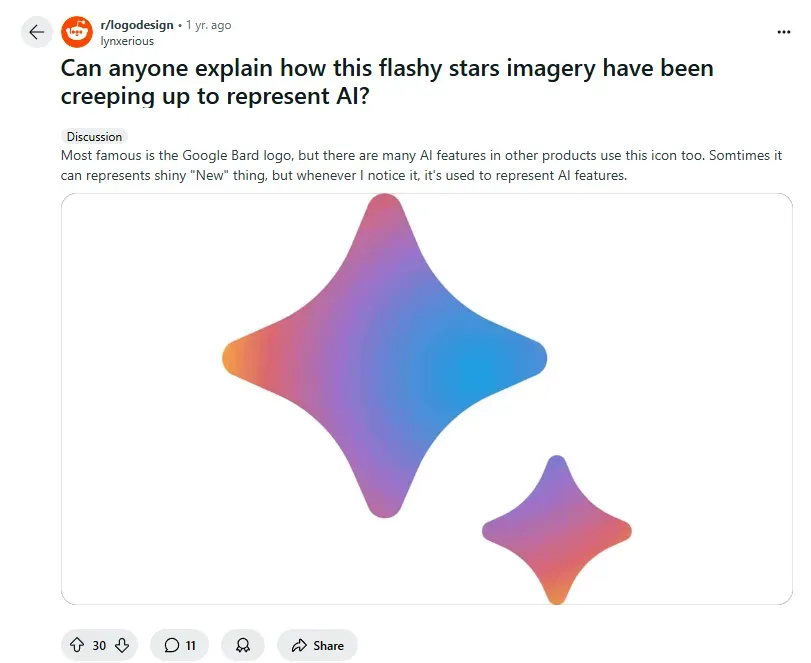
People often look up at the stars and see them as a symbol of escaping everyday life, freeing themselves from the confines of time and space. Isn’t that notion quite similar to the early internet’s theoretical aspirations? We wanted to create a world in another dimension where people could freely interact, unhindered by the constraints of time, space, and other curses of carbon-based life. I think the current AI craze’s fascination with star icons is also bound up with science fiction: AI is viewed as a symbol of technological progress, while stars represent infinite potential and unknown possibilities. By adopting a star symbol, AI apps quietly suggest “infinite possibility” and “constant innovation,” hinting at the boundless potential of technological development. As the physical world’s frontiers gradually vanish, human society seeks new “frontiers” to push forward exploration and growth.
Free collections are the soul of the vernacular web. Lots of people were building their pages with free graphics and lots of people were making collections. The many-to-many principle really worked. Making your own site and building collections was a parallel process for a lot of people. The early web was more about spirit than skills. To distribute was no less important than to create.
Technical limitations ironically became a catalyst for creativity, much like how the rough texture of watercolor paper can make a painting even more enchanting. This grassroots creativity undoubtedly felt like a romantic revival in the digital era. Its replicable and shareable nature broke the boundaries between creation and consumption, transforming every visitor into a potential creator. As a GitHub user, I believe free and open-source ideals are among the purest legacies of internet history. They build a gigantic theater with no entrance fee, where all participants can freely perform and listen.
In the end both cures delivered the same: a link to an address new to the user; an unknown topic, a surprise, an action, a deep web.
Links were once the language of the internet—the most original bridge connecting people to information and people to each other. This reminds me of Rickroll. As a cultural phenomenon, it’s a playful subversion of that language. You click what looks like an ordinary link and unexpectedly end up trapped in the absurd loop of “Never Gonna Give You Up.” This experience essentially betrays the “promise” of a link, but it also highlights its power. As the link evolved from the collaborative ideals of the early internet, to the efficiency era ruled by search engines, and finally to algorithm-driven content distribution, Rickrolling used a nonsensical, infinite, escape-proof video to undermine the link’s sense of “purpose.”
As all the instruments were standardized in 1983 the sound effectively goes no further than Italo Disco. There will never be any new and exciting sounds, only updated versions of old sounds. New sounds would only break the compatibility with all the existing MIDI files.
I feel MIDI is much like the “audio pixel art” of the early internet: each note is simplified to its bare essentials, like building blocks that piece together a cheap yet vibrant background melody for web pages. Similar to ASCII art or pixel drawings, MIDI used limited tools to create unlimited possibilities. In fact, it’s this sense of incompleteness that lends MIDI (and ASCII art) its uncertainty: different devices and interpretations can give it new life, infusing it with an absurd kind of beauty. When we look at MIDI, it represents a self-contained web aesthetic—it refuses to add realism or historical context to the sound. This “minimal audio-visual ensemble,” akin to the interactivity of GIFs on a webpage, stands as an early experiment in synesthetic experiences.
Does more faithful, high-fidelity technology bring us closer to the essence of art, or does a stripped-down approach like MIDI and pixel art—code-based expressions—come closer to the original logic of creation?
In a thousand years when the database is decoded by aliens, (or archaeologists), they’ll conclude the web was actually just a lot of frames.
This makes me think of modern front-end frameworks like Vue.js, which in some sense are the continuation and evolution of that idea: not only dividing the visual space, but also splitting logic and states, so each component is like an independent “frame” that organically interacts with others. Frames may be outdated, but they laid the foundation for today’s modular design mindset—which is still central to front-end development.
The tilde showed hierarchy and made the relation of users to the internet transparent. A quick glance at the URL and you could see the provider, university or institution that granted access.
With the rise of decentralized domains, this hierarchical structure has gradually blurred. The expansion of anonymity has given individuals more freedom, yet it obscures the source of power, making identity appear independent while still relying on underlying technical frameworks. I think those “really cool guys” who still keep the tilde take pride in deeply understanding the technical rules of the game.
When the web belonged to amateurs it belonged to the people. You knew that behind this page and email address was a person you could contact with a question, admiration or an insult. And people did.
That potential for immediate dialogue carried our longing for real interaction, as opposed to the fragmented nature of today’s social media, where speech is reduced to clicks, likes, and silent streams of data. “Mail me” gave each individual the right to talk directly to another person, rather than relying on “likes” or “shares” as superficial substitutes for genuine communication.